Showing posts with label D. Appendix 1: research for main product. Show all posts

Thursday, 7 April 2011

How Is Gender Represented In Horror MOVIES?

Gender in horror movies is mainly represented with a female protagonist who survives to the end. This counteracts the target audience as the main audience for the horror genre is teen males, normally in groups. The second most common is couples, going so they can cuddle up in the cinema and the man can protect the girl from the scary film. The main protagonist (which as I have said is normally female) tends to have an androgynous style, and isn’t portrait in a sexual manner, normally domestic and shown in conservative light. Horror films tend to stick with the format of if a teenage girl or boy does something wrong then they are punished for it; they don’t get punished if they don’t have sex, do drugs, or break any rules. They must lead a clean and tidy conservative life.
In the three films we watched (Halloween (1978) The Shining (1984) and Eden Lake(2008)) we expect to relate to a strong masculine hero but in each we tend to create more of a attachment to the female protagonist and we seem to empathise with her even though a male audience wouldn’t be expected to.
In Halloween we relate to Laurie as the main protagonist for the film, she is mainly seen from a domestic stand point, as during the film her friends are sexualised and because of this act of sex they die, as does one of the boyfriends, this is because they left the domesticated roles of familial life to become sexual, this change doesn’t follow a conservative view and they were ‘killed for their sins’. In the film we see a more modernised aspect as men and women are given the same amount of visibility, however, there is an issue with male gaze, all of the girl beside Laurie are sexualised and domesticated, so if they aren’t at home cleaning, they are being sexualised by men. The view of Laurie does rescue this slightly as she is seen as more masculine and balances out the ideas of women being objects.
Throughout the film women are domesticated and sexualised and men are there to protect and save, but at the end, where our female protagonist saves the day (with slight aid from Dr Loomis) and gets rid of the male monster.
Throughout the narrative of the film it is about equal with who dies and who survives in terms of gender but it can be argued that it would be outweighed due to the female deaths being more important and vital to the story.
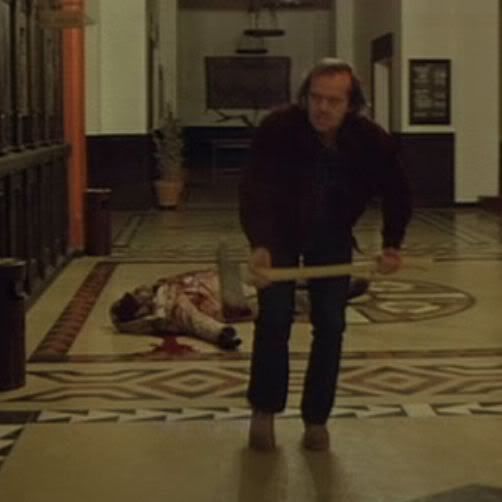
In the Shining we have an unfair split of men and women as there is a roughly a 60:40 split in favour to men.  Maintaining the idea that horror films like a conservative view and men have power and women don’t. Women are mainly portrayed domestically in this film and as familial. As Wendy is shown doing chores around the hotel. And the secretary is doing a stereotypically female job when she brings in coffee.  On the familial side of it, we see Wendy only as the husband of Jack and the father of Danny. We also see the daughter of Grady; the Twins are seen as familial as they are known as the daughters of Grady. There is a sexual aspect to this film but it is only small, where in room 237 we are forced into an aspect of male gaze, we see jack enter the room and naked lady come out of the bath, this however, isn’t the standard sexualisation that we first think as when jack begins to become intimate with the mysterious naked lady she transforms into a repulsive rotting corpse, which, after we look at the naked women in a sexualised way we see that it was in fact wrong to do so because now we are staring at naked, rotting, old lady making this more of a lesson to the watcher, saying, don’t look at women for their appearance, as appearances are deceiving.
  The males in this movie are portrayed as people attempting to protect, Jack only takes the job to provide for the family, Dick Hanoran wants to save Danny from Jack and the police officer manning the radio wants to make sure there ok and that they keep in contact. All of these positions are there to protect the family from harm but in the end they all fail and it is down to Wendy to save Danny from Jack and escape the evil of the hotel with the snow cat.
In the film we see a number of deaths, which are 3 girls and 2 guys, but this in terms of the ratio to guys and girls means that whilst only a small percentage of men die all but one woman die, Wendy, who saves Danny and takes him to a safer place, we assume. Due to the way the film kills off most of the women, the men that are left seem to have a more powerful offset, even though the main protagonist and the one we seem to relate is Wendy. There is an argument that we relate to Danny more but in the end he has to be saved by his mother and if it wasn’t for Wendy pushing him out of the window he would have been captured by Jack and more than likely killed. Throughout the film we see Jack, Wendy and Danny as a family and this makes it all the harder when we see that Jack wants to kill Wendy and Danny, it is actually hard to imagine the way he would do it which makes it seem as if an  villain there is still ‘normal’ Jack in there somewhere.

Tuesday, 7 December 2010

The Role of the Mighty Distributor!!!

The distributor has a key role in the film industry, there job is to show the film to the audience, via advertisement and showing the film. Distributors have to deliver to the largest audience they can with the material they have been given. Without the distributor there would be very little film industry, nothing would be advertised and the films would struggle to sell out of the cinema.
For the distributor they have many areas to cover, one being the film value chain, which are Cinemas, Home entertainment (DVD, Bluray & Online), Pay/Subscription TV and Free to air television. Cinemas offer the best place to view a film as you can be completely taken into the story and be fully immersed in the film. When attempting to get a film into the cinema the distributor must discuss it with the following: Film-makers & Producers, Exhibitors (who will present the films), External Partners, such as publicists and advertising agencies. Cinemas are a unique place for films to be advertised as it offers a place for film goers to see a film in the best way possible and to see what films they would want to see the next time they go to the cinema.
UK distributors obtain there films via 4 different sources:
1. A third party sales agent, acting on behalf of a producer
2. A flow of content from a parent studio
3. A studio or production company with whom the distributor has negotiated an output deal.        
4. A single title acquired at any stage before, during or after production.
There is high competition between distributors as to how they get there product and when they get it making it a fierce market. The distributors will look for new films which are likely to make a huge profit, are original and look incredible, you have to also factor in the idea of a local film. British made films sell better in Britain. Distributors like to have a deal in place with producers before the film in is in production based on its marketability and playability. For a producer to achieve this they need to seek finance from another area, such as:
1. Pre-sales via a third party.
2. Bank loans (but not best in a economic decline)
3. Investors
4. Private individuals
5. Tax Schemes
6. Public subsidies
The distributor has to sign a contract with the producers as to what they can do with the film. such as release it in cinemas, publicise it and to be locally edited to support the surrounding area.
When working with higher budget films the distributor is more likely to be involved earlier on so they can work on the advertising of the product to build up more of a hype for the film. When a distributor is bought in earlier on they then have some control of the project and it's development. Sometimes the distributor makes a advanced commitment so they can get the licence of distribution and theatrical prints and advertising. When a broadcaster contributes to a film, like film four, they are likely to pre-secure TV rights as part of the deal so they can get ahead of other broadcasters in this case the distributor will only have he rights to cinema, DVD/Bluray and downloads. The distributor will right a report about the marketing of the film such as spend, forecasts and actual revenues. This will be done quarterly for the first year, and if the film is really popular this would carry over for a second year bit other wise the second year would only have 2 reports and that would be the same each year.
The distributor must work out estimates with the producers and the low medium and high film turn overs so they can work out what profit they can turn over as they will need to turn a profit for the film to be a success. The distributor must figure out there target audience demographically and psycho-graphically so they can target the film at the largest audience they can. a different type of audience needs a different type of advertising and sales technique. although the distributor must attract a huge audience by making the film appeal to a wide audience but they must not lose the core target audience as the main one. For example a comedy horror which is primarily a comedy shouldn’t be shown as the scariest horror film because it will scare away the people going in for the comedy.the ways that the films are shown in different ways is through other forms of media, such as posters, online, mobile and TV advertisements. Another way is a form synergy by selling merchandise, McDonald's is always good for selling toys the publicise films, which is a form of synergy. but other merch such as t-shirts, film soundtracks and other such goods are sold in there bucket loads to publicise the film.
The key to the distributor is to excite the audience about a film they have yet to see, they only have one chance to make this impression as most people decide early on what films they want to see and don’t want to see. inspiring a young audience is always a attractive prospect as they have the ability to bring in bigger audiences as the younger the film goer the more chance they will have to bring family along but if there slightly older there is more chance they will go in a group.
Originally films came out in the Us then spread over the world, but now there is more of a fight to get it to your own country first. in the first week a film can pass £100m with a international opening. and this will carry on as the European, Asian and African markets grow. Ticket sales are currently worth 850 million making the UK one of the most lucrative film countries, but with everything else you can get out of a cinema these days, such as sweets and drinks and other releases like DVDs it can turn over £2.5 billion.
The distributors office is filled with scripts to be carefully read through, each script is a potential pay packet, so each script is carefully read and appreciated in anyway it can be. each script has to be read through to work out:
  1. Marketing
  2. Publicity
  3. Sales
  4. Technical
  5. Acquisition & Legal
  6. Finance & Accounting
  7. Administration
The role of the distributor is to excite a audience to the film they are trying to publicise as to attract a wide audience to make the film as successful as possible. With out them the film industry would die out because no one would be really excited to see a film unless they had done the background checks to see if the film was being made, who was in it and so on. This is not a easy job, but with out it movies would now be what they are today.

Tuesday, 9 November 2010

3 Horror Movie Trailers That Made Us Go...Cool. We'll Use That!

Devil: The Official Trailer

What Josh and I liked about this trailer is how the use of a match on action cut from the lift to the CCTV footage in the security room of the lift and how there is a quick flash of their dead bodies and blood on the walls.


The trailer had inter-titles but no voiceover, which we prefered as it didn't disrupt the music or the actor's dialogue which is vital to this trailer. It broke up what was happening so that suspense could be built and we could be drawn in.


A typical horror convention of this trailer is the setting. The claustrotophobic entrapment styled environment adds to the horror as we know that they can not escape easily without harming themselves.


The Hills Have Eyes: Official Trailer

What Josh and I liked about this film is the fact that this film didn't give much of the plot away, just so much that we know that this family are isolated in the middle of nowhere but they are not alone. The use of still frames edited together at speed to create a montage effect, it influences or views of the film to be terrifying and fast-paced.


A convention of this trailer is the fact the audience in the cinema are put into a voyueristic stand point. We see the young woman in a bikini and we zoom and bit closer into the shot where we just see her from the chest up and that it stills and fades out, also when we see the hand stroke the other woman's face and we witness that dead on, so that attracts the target audience which are mainly teenagers.


A Horror convention that is used in this trailer is the character types. We have the oldest man who does seem the main protaganist who we want to idolise with, we have the woman who is sexualised, the young boy who again we could idolise with.
Obviously we have these monsters, who we don't fully see, but we know that they are not 'normal'.


Sorority Row: Official Trailer


A convention of this film that Josh and I like would be the production value that this film will have for teenage boys. The trailer shows college girls wearing next to nothing, this appeals to a sexualised teenage audience.
The horror convention that we like in this film is the sound. We like the fact that they use real songs for the soundtrack and how the song is cheery when the situation definatly is not. This is a good use of a contrapuntal soundtrack This repeats with the song at the end, when it is girls are singing and clapping and it echos and gently gets quieter. This is a convention that we would like to create in our horror movie trailer.

Wednesday, 13 October 2010

Narrative Theroys In The Shinning


The narrative structure theorists are Propp, Todorov, Strauss and Broadwell & Thompson.

Propp holds the theory that in folk stories there are 8 identifiable character roles and 31 narrative functions, altough these may not all fit into a story at once there should be most within the narrative. In The Shinning there are  7 of 8 of the character roles although they are unclear.

1) The Villian - Jack/Hotel
2) The Hero - Danny/Wendy
3) The Donor - Dick Hallorann
4) The Helper - Dick Hallorann
5) The Princess - The Snow Cat
6) Her Father - N/A
7) The Dispatcher - The Hotel Manager
8) The False Hero - Jack

His 31 Narrative functions  which fit with the narrative structure and allow us to think more about the story of The Shinning. But not so much 21-30.

Todorov: He came up with two diagrams to describe the narrative structure of a story, which he discovered could be use for most stories.

both of his structures fit the plot of the shining where there is a equilibrium which is disturbed then there is struggle to a new better equilibrium. but there is no real closure from the film but it does allow to keep a structure.

To begin there is equilibrium with jack looking for a job, then the crisis happens when they go to the hotel and Jack goes crazy, then they reach a new equilibrium when they escape the hotel.

Strauss: Strauss uses the idea of binary opposition, meaning having two opposites going against each other, good and evil (Danny and Jack) Sane and Insane (Jack and Sane Jack) Past and Present (Jack and Delbert) its not always a definite yes or no answer, somethings are left un answered. the benefits of this is that it shows us a clear sense of good and evil in the story.


Broadwell and Thomas: they said that when watching a film the audience tries to connect to the event to make sense of the situation. connected with this is the kuleshov experiment. the idea behind this is that audiences have there own ideas about how the film works and that is how we join pieces together which is aided by continuity editing. and the director can control the emotion with camera movement and editing types. In the Shining this is used when we see Danny on his trike and he sees the twins and the camera switches between them Danny and them dead, creating emotion and tension.


Monday, 11 October 2010

Return of the Repressed


One Web deffinition of Mr Freuds theroy is:
The return of the repressed is the process whereby repressed elements, preserved in the unconscious, tend to reappear, in consciousness or in behavior, in the shape of secondary and more or less unrecognizable "derivatives of the unconscious." Parapraxes, bungled or symptomatic actions, are examples of such derivatives.

Basically, a event in the past effects the present due a date or a symbol which represents the event.

For example, in the film Halloween, the killer returns to the town he killed his sister in on the same date that he commited the crime.


Tuesday, 28 September 2010

Monday, 20 September 2010


Creep Video trailer, one of my favourite horror/thriller videos